At the Echlinville Distillery, field-to-glass whiskey production has become a reality
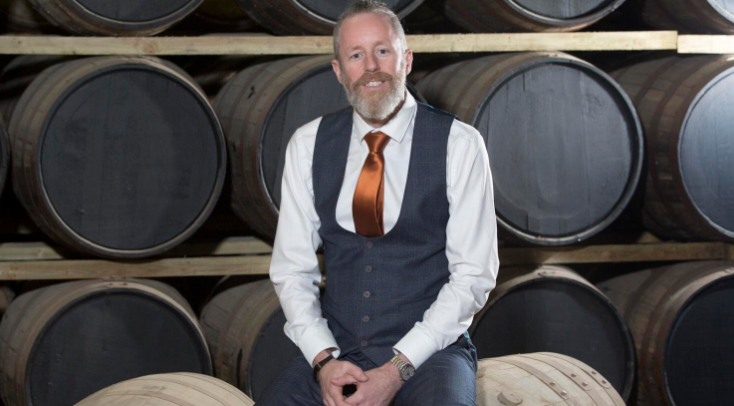
Jarlath Watson credits the Echlinville Distillery’s single estate approach with giving its whiskeys a sense of provenance, community, tradition and authenticity. “A sense of place that’s completely unique to us,” is how Watson, the distillery’s head of whiskey and financial director, describes it.
Echlinville’s adventurous story is of the land from which it originates and the people who bring it to life. Tucked away in a gorgeous corner of the Ards Peninsula in Co Down, it’s run by Watson and Shane Braniff, a local businessman and farmer who has farmed the land since since 2007.
From the outset, they have never been ones to follow convention. Before they even got their distilling license, one of their first moves was to resurrect an old iconic brand, Dunville’s, in 2012. This earned them tremendous praise and in 2021, they did the same with the much loved Old Comber brand.
They now produce whiskey for these brands and the host of others they own completely on the grounds of the distillery. And I mean completely, as in every single step is done there, as Watson tells me.
“We are a true single estate, field-to-glass distillery, the first in Ireland to do everything on-site, from the ground up,” he says. “Every step of the production process, from sowing and growing, harvesting, malting and milling, mashing and fermenting, distilling and dunnage, maturing to vatting, blending, bottling and labelling is completed by us.
Dunnage, for the uninitiated, is an old school three barrel stack style of ageing whiskey. Echlinville is reconnecting the farm, the floor malting the distilling and the dunnage, or as Watson puts it, “weaving together again the people and processes in whiskey making that have become unbound by industrialisation”.
It’s an amazing commitment to tradition and to capturing the terroir of the estate, but its not the distillery’s only defining characteristic. Watson spoke at great length about their two whiskey stills and why they adhere to a double distillation method and not the triple distillation that is more common with Irish whiskey.
“Our mantra was always to produce waxy, full-bodied and full-flavoured whiskeys. We were never going to run a third distillation, as we believe this would sacrifice too much of the character we wanted in our whiskeys,” he says. “Our Scottish cousins have shown us that double distilled single malts can be some of the best in the world, so that was never in doubt.”
They have also pioneered a rather unique, slow style of extracting flavour, a process they have dubbed trickle distillation.
“Creating an exceptional whiskey is all about time; there’s no substitute for it. At Echlinville, that’s not just about the time the whiskey spends in casks, it’s also very much about the time taken to distill,” he says.
“The slower the distillation, the better and sweeter our spirit, so we slow the still right down to ensure maximum copper contact for our liquid, and achieve a spirit that is as full bodied and complex as it is delicate and sweet. It is not the most economical way to produce whiskey, but as I’ve said before, we do not and will not compromise on quality.”
Echlinville’s clear spirits are also quite exceptional. The gins all use barley grown on the farm, as well as a heady mix of local botanicals. The vodka, called Weaver’s, is clean and crisp, superb in a Moscow Mule, and as any poitín fan will tell you, has done stellar work in this category too, especially with the famous Bán brand.
Here are just a few of the exceptional releases that have come from Echlinville’s stunning portfolio. For details of the distillery tour, and stocksts, see echlinville.com.